Smarter store replenishment: from reacting to anticipating
· 7 min read
Most store replenishment workflows tell associates what is empty right now. We’re building a new replenishment capability designed to tell retailers what matters most next: which products are most at risk of costing sales, and which action is likely to have the greatest impact. It sorts the existing handheld replenishment list by expected impact, explains the reasoning behind every recommendation, and adapts to each retailer’s priorities.
The goal is simple. Spend finite floor hours on the work most likely to protect sales.
The problem with a list that only sees the present
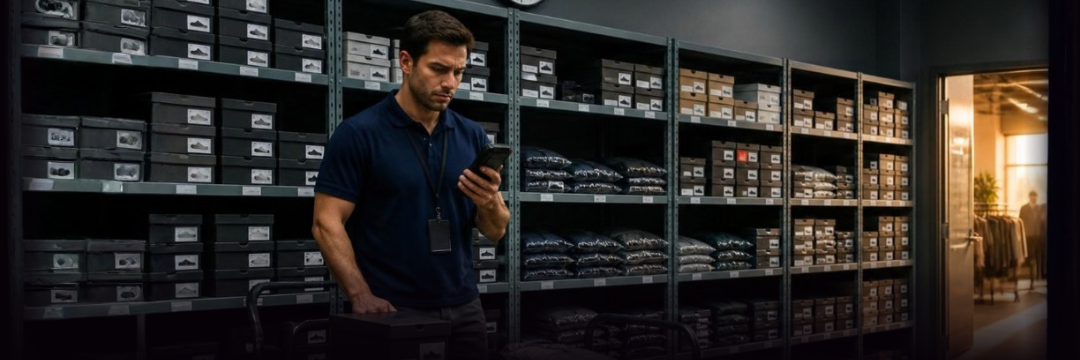
It is 7:40 on a Saturday morning. The doors open in twenty minutes. An associate stands in the stockroom with a handheld scanner, a cart, and a replenishment list sixty lines long. Every line looks equally urgent. The list shows what is missing from the floor, but it does not show which gap will cost the store the most by noon.

So the associate starts at the top. By the time the store is busy, the fast-selling size in the promoted line may still be sitting in the back, while a slow-moving accessory has been neatly faced.
That is the limit of reactive replenishment. It is accurate about the present and silent about what comes next.
Why out-of-stocks still cost retailers so much
Store replenishment is the process of moving stock from the backroom or receiving area to the sales floor so that products are available when shoppers look for them. When it falls behind, the cost is measurable.
- IHL Group estimates that inventory distortion, the combined cost of out-of-stocks and overstocks, reached approximately 1.77 trillion US dollars globally in 2025, equal to roughly 6.5% of worldwide retail sales. Out-of-stocks account for about 1.2 trillion US dollars of that total (IHL Group, 2025).
- A widely cited study by Gruen, Corsten and Bharadwaj found an average worldwide out-of-stock rate of 8.3%. When shoppers encountered a stockout, 31% bought the item at another store and 9% did not buy at all.
- In fashion specifically, AlixPartners’ 2024 Consumer Sentiment Index, based on a survey of 9,000 fashion consumers, reported that two-thirds of shoppers will leave a store and buy from another retailer when the item they want is out of stock.
The evidence suggests that the most expensive gap is rarely the one a static list puts first. Not every empty location carries the same commercial weight, yet most replenishment workflows treat them as if they do.
What does it mean to anticipate replenishment needs?
Anticipatory replenishment shifts the question from “what is empty?” to “what is most at risk, and what should we do first?”.
The capability we are building combines current floor-stock need with demand and commercial signals. In general terms, demand signals indicate how quickly a product is likely to sell, while commercial signals indicate how much that product matters to the business. Together, they allow the system to estimate which tasks are most likely to protect sales.
This is the first step in a broader direction: helping stores anticipate which products are most at risk next, rather than reacting only to the floor as it looks now.
How impact-ranked replenishment fits into existing store workflows
A new capability often fails at the point of adoption. If associates need a new screen, a new process, or a new habit, the benefit can disappear in the first busy weekend. We’ve designed this capability to avoid that friction.
The recommendations are built into how store teams already work:
- Familiar workflow. Recommendations appear inside the existing replenishment list, with no new screens for associates to learn.
- Explainable. Each recommendation shows the store signals behind its priority, so associates and managers can see why an item ranks where it does.
- Your priorities. Retailers can customize the policy by site or region, keep an out-of-stock-first workflow and use the ranking to order it, or filter to recommended items only.
Explainability matters more than it may first appear. An associate who understands why an item sits at the top of the list is more likely to trust the ranking and act on it. A recommendation that cannot be explained is, in practice, a recommendation that can be ignored.
Making the outcome of replenishment visible
Store managers rarely lack activity data. What is harder to see is whether that activity protected sales.
We are developing a new store dashboard experience that connects replenishment activity with availability, sales, and projected revenue risk. By placing replenishment activity alongside each store’s unique demand patterns, the dashboard is intended to help managers:
- Identify priority products for their specific store.
- See when stock gaps may be costing sales.
- Plan labor around the moments that matter most.
Understanding store team activity
The dashboard will also allow managers to review replenishment activity across the team, recognize engagement, and identify patterns worth sharing between associates or stores. For operations leaders, this offers a practical way to turn individual good habits into consistent store practice
What the early evidence shows
We have evaluated the approach in a controlled store simulator driven by production sales patterns. Across matched 30-day scenarios, the impact-ranked approach consistently outperformed the baseline out-of-stock-first approach. This is promising, but it is modeled evidence.
Simulation can show whether a prioritization logic is sound under realistic demand conditions; it cannot fully reproduce the variability of a live store, from staffing gaps to unexpected traffic. The next step is validating the recommendations against real outcomes in stores. For retailers, that distinction is worth holding onto. The direction is clear, and the early signal is positive. In-store validation will determine the size of the effect.
What this means for store operations leaders
Labor on the sales floor is finite. Every morning, someone decides the order in which replenishment work gets done, whether that decision is made deliberately or simply inherited from the way a list is sorted.
We’ve heard a consistent challenge from customers: when replenishment workloads are large, associates do not always have a clear way to decide what to tackle first. Smart Replenishment is our response.
– Cailee Rye, Chief Operating Officer, ClarityRFID
Operations leaders evaluating their current approach may find these questions useful:
- Does the replenishment list distinguish between a gap that costs sales and a gap that does not?
- Can associates see why one task should come before another?
- Can managers connect replenishment activity to availability and sales outcomes?
- Can priorities be adjusted by region, format, or site without rebuilding the process?
If the answer to most of these is no, the store is likely spending some of its most valuable hours on work that matters least.
The right gap first
Reactive replenishment has served retail for decades, and it remains accurate about what is missing today. The opportunity now is to add foresight: to rank the same familiar list by impact, explain every recommendation, respect each retailer’s priorities, and make the outcome of replenishment visible to the people accountable for it.
Early simulation results suggest that this shift is worth making, and in-store validation is the next step.
Every store will always have gaps on the shelf. The stores that win are the ones whose teams fill the right gap first.
Frequently asked questions about smarter store replenishment
Smart store replenishment is an approach that prioritizes restocking tasks by expected business impact rather than by shelf status alone. It combines current floor-stock need with demand and commercial signals, so associates can address the products most likely to cost sales if left unattended, instead of working through a list in a fixed order.
Out-of-stock-first replenishment treats every empty location as equally urgent. Impact-based replenishment ranks the same tasks by their likely effect on sales, using demand and commercial signals alongside floor-stock need. Retailers that prefer an out-of-stock-first workflow can keep it and use the impact ranking to order the tasks within it.
No. We are designing the recommendations to appear inside the existing handheld replenishment list, with no new screens for associates to learn. Recommended items are clearly flagged and the list is sorted by impact, so the workflow remains familiar while the order of work reflects which tasks are most likely to protect sales.
Not yet. We evaluated the approach in a controlled store simulator driven by production sales patterns, where it consistently outperformed an out-of-stock-first baseline across matched 30-day scenarios. This is promising modeled evidence. The next step is validating the recommendations against real outcomes in live stores before drawing firm conclusions about in-store performance.
IHL Group estimates that inventory distortion, the combined cost of out-of-stocks and overstocks, cost global retail approximately US$1.77 trillion in 2025, with out-of-stocks accounting for roughly US$1.2 trillion of that total. Earlier academic research found that shoppers who encounter a stockout frequently buy elsewhere or abandon the purchase entirely.