

Catch the error at the carton.
A carton packed wrong at the supplier becomes a short delivery at the DC, a stock discrepancy in the store, and a canceled order three weeks later. Clarity Supply Chain audits the carton while fixing the error still takes minutes rather than weeks.
The manifest builds itself as you fill the box.
A carton is only as good as the record of what went into it. Carton Packing assigns the container an ID, reads each item in as it goes, and produces a definitive list of SKUs, sizes and counts tied to that carton.
- Carton Packing assign a unique carton ID, scan items in, and validate the contents as you go
- Real-time validation the operator sees the manifest forming rather than reconciling it afterwards
- A definitive manifest every downstream audit is measured against this list
Because the manifest is produced at the point of packing, a discrepancy found later is attributable to a stage rather than to the whole chain.
Speed or precision, chosen per carton.
Checking a carton is one job pulled in two directions, and any single way of doing it gives up one of them. Clarity covers both ends, so the operator picks what the moment calls for rather than living with a compromise.
Fast and Bulk Auditing
Fast Auditing verifies a carton's contents by RFID, with carton details, pending packs, and live results on one screen. Bulk Auditing does the same across a group of cartons expected in a location, confirming every one is present, naming the ones that are not, and updating inventory status. The pace a working dock and a full pallet need.
Quality and Carton Auditing
Quality Auditing is SKU-based and deliberately slower, reading items one at a time and able to check specific packs, for the carton that matters or the dispute that needs settling. Carton Auditing lets the operator scan cartons into a batch themselves and audit all of them together against what those cartons should hold.
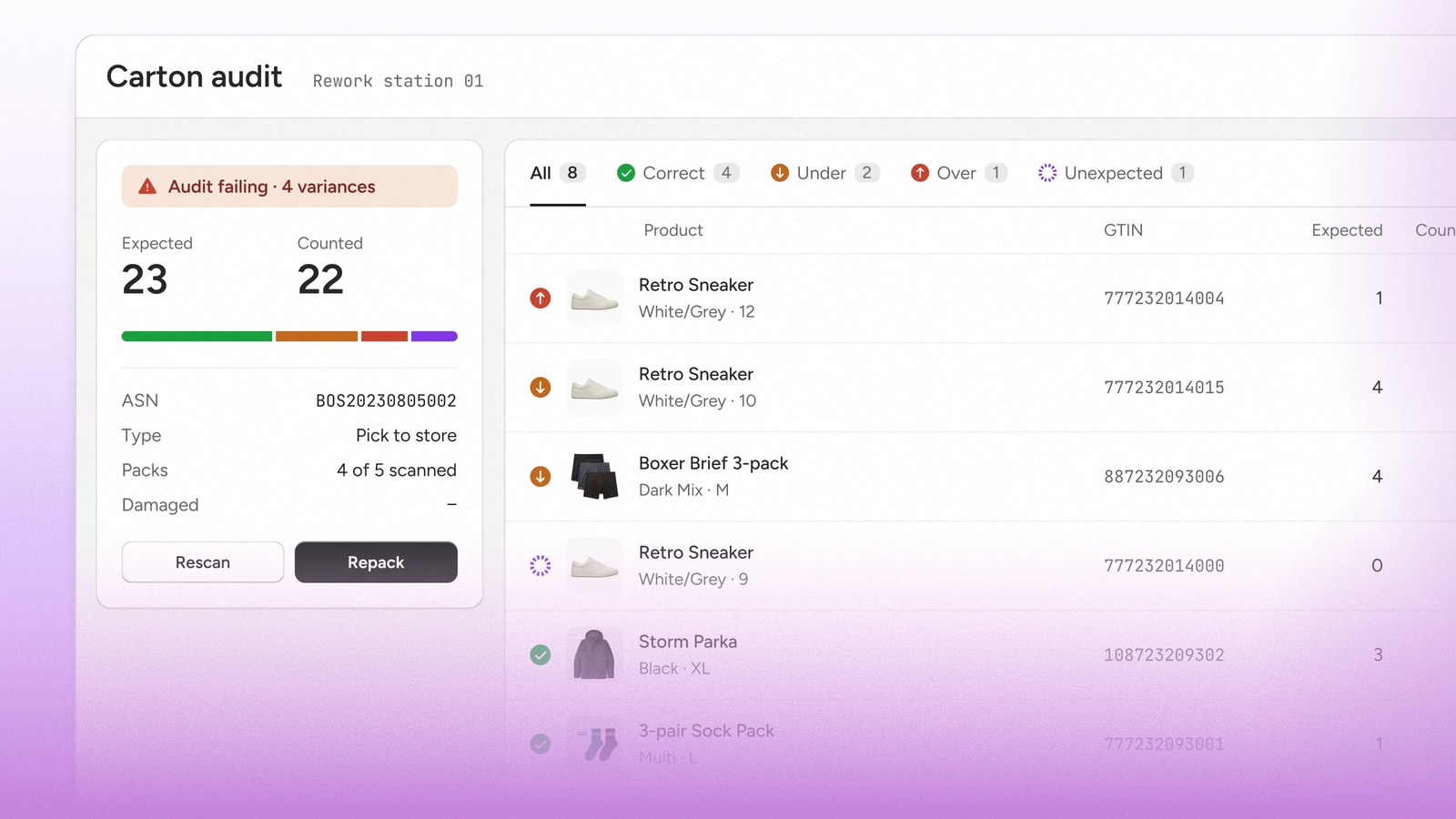
Volume when you want it, certainty before you need it.
Two tools that sit underneath the audit workflows: one for reading a great many tags quickly, one for proving the tags are worth reading in the first place.
Fast Tag Read
Read a high volume of tags in a short window and watch the results arrive in real time. Built for rapid inventory confirmation, spot checks, cycle counts, and the ad-hoc question that needs answering before the truck leaves.
Tag Diagnostics
Verify that tags are properly encoded, unique, and being captured reliably by the connected reader, before they reach a production workflow. The step that stops a tagging problem becoming an audit problem.
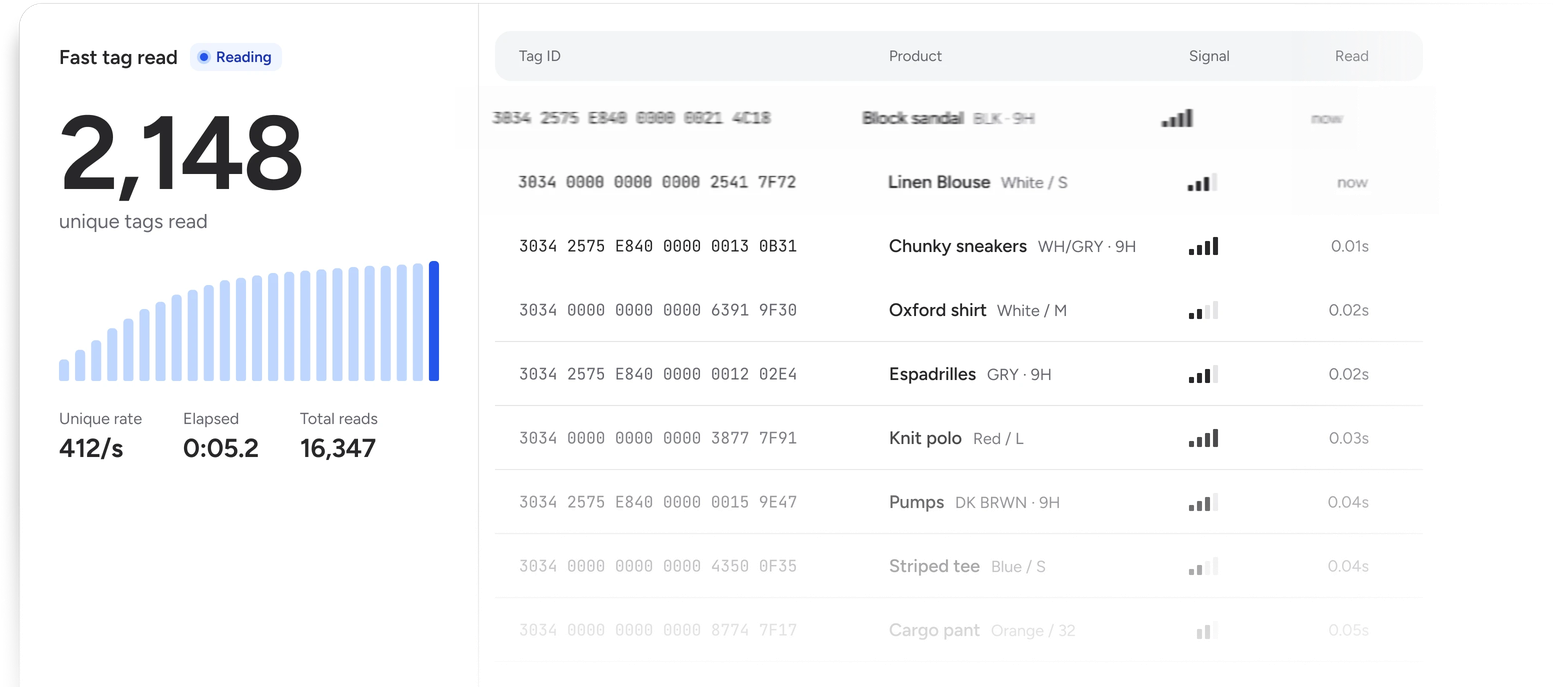
What happened, in the order it happened.
When a count does not agree with a manifest, the useful question is when it stopped agreeing. The Activity Feed is the centralized, real-time log of every significant event across the workflows: audits, scans, expected sends.
- Activity Feed a live log of events and transactions across every workflow
- Diagnostic use trace a discrepancy back to the action that caused it
- Recent history a high-level view of what the site has been doing, without opening four screens
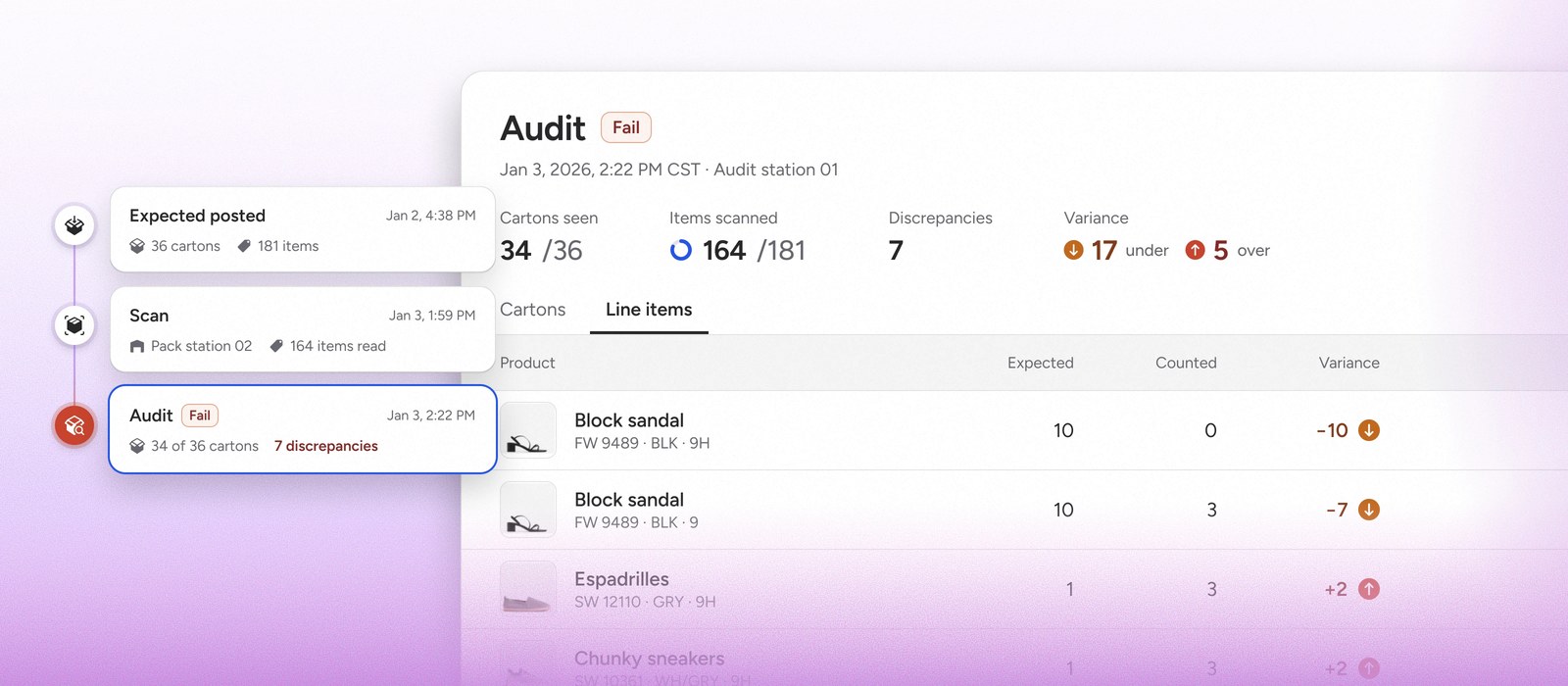
The carton becomes the shelf.
Supply Chain and Store are two halves of one item-level record. A carton audited on the dock arrives in a store that already knows what is inside it, and a store count that finds a shortage can point at the carton it came in.
Upstream, by the carton.
- Packing the manifest created at source
- Auditing four modes, from dock speed to dispute precision
- Diagnostics tags proven before they travel
Downstream, by the item.
- Receiving against the ASN the carton already carries
- Counting item-level accuracy on the floor
- Selling replenishment, fulfillment, and markdowns
Prove it on your own cartons.
Bring a real pack-and-audit cycle to a free POC and find out what your carton accuracy actually is, measured the same way twice.